Thursday, May 21, 2015

TDSSNIClient initialization failed with error 0x80092004, status code 0x1. Reason: Initialization failed with an infrastructure error. Check for previous errors. Cannot find object or property.


2015-02-17 12:27:38.19 spid15s     Error: 26014, Severity: 16, State: 1.
2015-02-17 12:27:38.19 spid15s     Unable to load user-specified certificate [Cert Hash(sha1) "5B4FF9FFF4E6752A3AD51489E1A9C455E580BCC3"]. The server will not accept a connection. You should verify that the certificate is correctly installed. See "Configuring Certificate for Use by SSL" in Books Online.
2015-02-17 12:27:38.19 spid15s     Error: 17182, Severity: 16, State: 1.
2015-02-17 12:27:38.19 spid15s     TDSSNIClient initialization failed with error 0x80092004, status code 0x80. Reason: Unable to initialize SSL support. Cannot find object or property. 
2015-02-17 12:27:38.19 spid15s     Error: 17182, Severity: 16, State: 1.
2015-02-17 12:27:38.19 spid15s     TDSSNIClient initialization failed with error 0x80092004, status code 0x1. Reason: Initialization failed with an infrastructure error. Check for previous errors. Cannot find object or property. 
2015-02-17 12:27:38.19 spid15s     Error: 17826, Severity: 18, State: 3.
2015-02-17 12:27:38.19 spid15s     Could not start the network library because of an internal error in the network library. To determine the cause, review the errors immediately preceding this one in the error log.
2015-02-17 12:27:38.19 spid15s     Error: 17120, Severity: 16, State: 1.
2015-02-17 12:27:38.19 spid15s     SQL Server could not spawn FRunCommunicationsManager thread. Check the SQL Server error log and the Windows event logs for information about possible related problems.
Event ID 17182: TDSSNIClient initialization failed with error 0x7e, status code 0x3a.

Event ID 17826: Could not start the network library because of an internal error in the network library. To determine the cause, review the errors immediately preceding this one in the error log.

Event ID 17120: SQL Server could not spawn FRunCM thread. Check the SQL Server error log and the Windows event logs for information about possible related problems.

Solution :

1. Check 'Forced Encryption' (Turned False) and 'Certificate' value is cleared under SQL Server Configuration Manager.
2> Check the following registry key 
HKEY_LOCAL_MACHINE\SOFTWARE\Microsoft\Microsoft SQL Server\MSSQL10.SQL2008\MSSQLServer\SuperSocketNetLib\Certificate
and clear the Certificate values.


Sunday, May 10, 2015

Script to get the SQL Logins information


Login type descriptions

S = SQL Server user(SQL_USER)
U = Windows user(WINDOWS_USER)
G = Windows group(WINDOWS_GROUP)
A = Application role(APPLICATION_ROLE)
R = Database role(DATABASE_ROLE)
C = Certificate mapped(CERTIFICATE_MAPPED_USER)
K = Asymmetric key mapped(ASSYMETRIC_KEY_MAPPED_USER)


Using below script you can list all Login Accounts in a SQL Server

SELECT name AS Login_Name, type_desc AS Account_Type
FROM sys.server_principals 
WHERE TYPE IN ('U', 'S', 'G')
ORDER BY name, type_desc

Using below script you can list all  SQL Login Accounts (Not windows logins)  only in a SQL Server 

SELECT name
FROM sys.server_principals 
WHERE TYPE = 'S'
ORDER BY name, type_desc

Using below script you can list all Windows Login Accounts (Not SQL Logins)  only in a SQL Server 

SELECT name
FROM sys.server_principals 
WHERE TYPE = 'U'

Using below script you can list all Windows Group Login  (Not SQL Logins)  only in a SQL Server 

SELECT name
FROM sys.server_principals 
WHERE TYPE = 'G'

Wednesday, May 6, 2015

PDW Database Restore

Using below command you find the backup header information for all backup sets on a given backup devise

Restore headeronly from disk = '\\10.10.10.10\PDWBackups\FullBackup_02052015\DWLOADER_staging'


Restore a database using Full backup 

Restore database DBAAdmin from disk = '\\10.10.10.10\PDWBackups\FULL\05052015\AdventureWorksPDW2012.bak'


Restore a database using differential backup 

Restore Database DBAAdmin1 from disk = '\\10.10.10.10\PDWBackups\FULL\05052015\AdventureWorksPDW2012_Diff.bak' 
with BASE = '\\10.10.10.10\PDWBackups\FULL\05052015\AdventureWorksPDW2012.bak'  
 
In above statement full backup is '\\10.10.10.10\PDWBackups\FULL\05052015\AdventureWorksPDW2012.bak'  

and differential backup is \\10.10.10.10\PDWBackups\FULL\05052015\AdventureWorksPDW2012_Diff.bak' 


Limitations in the restoration is 

The backup set can only be restored to a SQL Server PDW destination appliance that has the same number or more Compute nodes than the source appliance. It cannot have fewer Compute nodes than the source appliance.

Monday, May 4, 2015

PDW Database Backup


The backup is stored in the G:\Backups directory on the appliance 

There are two type of backup 
Full Backup : A full database backup is a backup of an entire  PDW database similar to SQL Server Backup.

Differential Backup :A differential database backup only includes changes made since the last full PDW Database backup 

Syntax :  FULL BACKUP 

use master

backup database AdventureWorksPDW2012 to disk = '\\10.10.10.10\PDWBackups\FULL\05052015\AdventureWorksPDW2012.bak' 

The above statement creates the full backup of of the AdventureWorksPDW2012 database . The backup will be stored in \\10.10.10.10\PDWBackups\FULL\05052015\ location. To grant access on this shared location please use sp_pdw_add_network_credentials  command 


Syntax :  DIFFERENTIAL BACKUP 
backup database AdventureWorksPDW2012 to disk = '\\10.10.10.10\PDWBackups\DIFFERENTIAL\05052015\AdventureWorksPDW2012.bak with differential' 

 
You can not perform differential backup on master database

You can copy a database to a different appliance by copying the backup files to the G:\Backups directory on the Backup node of the target appliance and then performing a restore. However, copying backup files to a different location can negatively impact restore performance. This can occur when the logical disk storage for the backup files varies from the original backup directory.
The target appliance for restoring the backup must have at least as many Compute nodes as the source appliance. The target can have more Compute nodes than the source appliance, but cannot have fewer Compute nodes.


Sunday, May 3, 2015

Execute queries in PDW

After login into PDW Server ( How to Login into PDW )

 Right click on the server name and click on New Query option in the pop-up window

It will open new window in right side 


Type the query to execute in right side window 


to execute query use below option 

 Mark the query which you want to execute and use CTRL + SHIFT+ E

or Mark the query which you want to execute and click on the below button


it use master database and execute the query and shown below results 


use below options to show the results in grid,text, file


How to connect PDW


You can login pdw using MS Visual Studio 2012/SQL Data Tools  or Nexus Query Chameleon


Lets try using Visual Studio 2012 

Goto Visual Studio 2012 icon and click 


Click on Run the program without getting help

you can see 


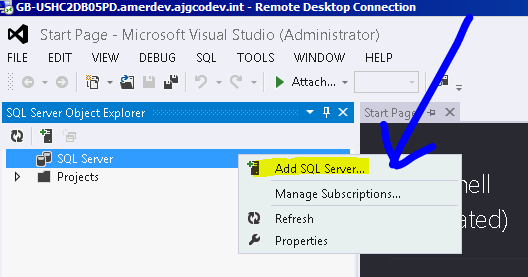
Click on View and select SQL Server Object Explorer 


now you can see below screen right click on the SQL Server 


Select Add SQL Server 


Provide the PDW server and Login & password details ( you can login using SQL Authentication or using Windows Authentication) 

and click on connect 

How to grant access on backup shared in PDW


How to grant access on backup shared in PDW

To backup the database we have to assign access permissions to a windows account that has write access to a file share on a target server.
sp_pdw_add_network_credentials '10.10.10.10','corp\adAcctLogin', 'PassWord'

To remove access to shared path  
sp_pdw_add_network_credentials '10.10.10.10','corp\adAcctLogin', 'PassWord'

To check who are all having permissions 
select * from sys.dm_pdw_network_credentials


Cannot access the specified path or file on the server. Verify that you have the necessary security privileges and that the path or file exists

If you received below error while attaching a .mdf file in cluster environment please follow below steps to resolve the issue ERROR Ca...